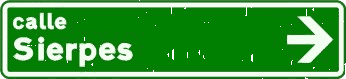
S-700
Places on the urban road network
Gives the names of streets, avenues, squares, roundabouts or any other point on the road network.
Catalogue section 3.16
They say that the places named are reached by following the arrow.
How to recognise them: A rectangular module with an arrow and the place it leads to.
In towns, directions are built up from pieces. The regulation describes these signs as modules used together or separately, with one shared purpose: saying that the place named is reached by following the arrow. What changes from one module to the next is the kind of place. S-700 names streets, avenues, squares, roundabouts and any other point on the road network. S-710 leads to places of interest to travellers: stations, airports, port boarding areas, hotels, campsites, tourist offices or the automobile club. S-720 is for places of sporting or recreational interest; S-730 for geographic or ecological places and those of monumental, historic or artistic interest, such as castles, monasteries or museums; and S-740 for places of cultural interest, such as universities, libraries or theatres. S-750 points to areas that draw lorries, goods and heavy industrial traffic.
The last two divide up the roads. S-760 leads to motorways and autovías and to the places reached by them; S-770 to other roads and the towns on them, and to other places of public interest not covered by S-700 to S-760.
Signs in this group that look alike, and what separates them according to their definitions.
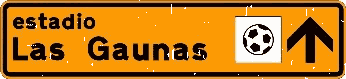 S-720
 S-730
S-720 leads to places where sporting or recreational interest comes first. S-730 leads to places of a geographic or ecological character, or of monumental, historic or artistic interest.
S-730 S-740
A museum or a monastery goes on S-730, with castles and palaces; a library, a theatre or a university on S-740, the module for places of cultural interest.
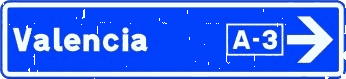 S-760
 S-770
S-760 leads to motorways and autovías and to the places reached by them. S-770 leads to other roads and their towns, and also to places of public interest that S-700 to S-760 do not cover.
8 signs
S-700
Gives the names of streets, avenues, squares, roundabouts or any other point on the road network.
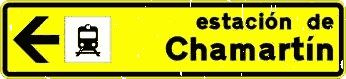
S-710
Marks places of interest to travellers, such as stations, airports, port boarding areas, hotels, campsites, tourist offices and motoring clubs.
S-720
Marks places whose main interest is sporting or recreational.
S-730
Marks geographic sites and places of ecological, monumental, historic or artistic interest, such as monuments, castles, monasteries, museums and palaces.
S-740
Marks places of cultural interest such as universities, cultural centres, libraries and theatres.
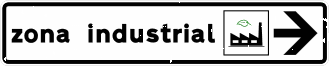
S-750
Marks areas that draw a lot of lorries, goods and heavy industrial traffic in general.
S-760
Marks the motorways and dual carriageways, and the places they lead to.
S-770
Marks roads that are neither motorways nor dual carriageways, and the towns they lead to, along with other places of public interest not covered by signs S-700 to S-760.
The definitions in the list follow the regulation's Spanish text. The introduction and the comparisons are ours.
Source: Reglamento General de Circulación — Anexo I, apartado 5: Catálogo oficial de señales de la circulación y marcas viales (Catálogo de señales verticales, tomo I) · Anexo I, apartado 5 (Catálogo de señales verticales de circulación, tomo I)
Keep going
Get the app
Everything above lives in the app for iPhone and Android. Free to start — no card needed.
Spanish driving theory, in your language
Available for iOS 15+ and Android 8+.