Catalogue section 3.9
Lane signs (S-50a–S-72b)
They set special rules for one or more lanes of the carriageway.
How to recognise them: A rectangular sign with a blue background showing the lane layout and its arrows in white.
How this group is laid out
Lane signs set special rules for one or more lanes of the carriageway, and their letters nearly always count lanes or pick a side. In the S-52 series, the lane that disappears and makes you move over may be the right or the left one, on carriageways of two, three or four lanes, one-way or two-way. S-60 to S-63 do the same for forks, and S-70 to S-72 for a lane joining from the left or the right. The S-53 signs announce the opposite, an extra lane in the same direction, and S-53a and S-53c add the speed limit for each lane.
Others reserve a lane. On the S-50 signs it is reserved by speed: only those travelling at least at the minimum shown may use it, and even then they must keep to the right-hand lane when conditions allow. S-51a reserves it for certain types of vehicle and S-51b for high-occupancy vehicles. S-64 and S-65 give cycles a lane alongside the carriageway: compulsory for them on S-64, only reserved on S-65. S-66 is a cycle lane running against the direction of the lane next to it.
How to tell them apart
Signs in this group that look alike, and what separates them according to their definitions.
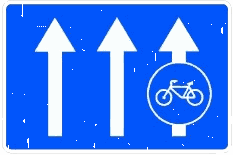 S-64a
S-64a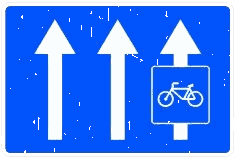 S-65a
S-65aS-64a requires cycles to use the lane it stands over and bars everyone else from it. S-65a reserves the lane for cycles and bars everyone else, but its definition does not require cycles to use it.
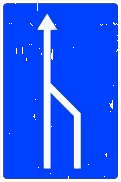 S-52c
S-52c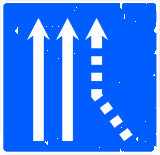 S-71b
S-71bBoth are used on two-lane carriageways in one direction. At S-52c the right-hand lane disappears and you have to move over; at S-71b a lane comes in from the right and merges with yours.
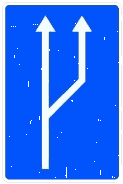 S-53
S-53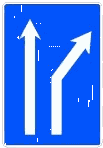 S-60b
S-60bS-53 announces that one lane becomes two in the same direction. S-60b announces that, on a two-lane carriageway, the right-hand lane splits off and changes direction.
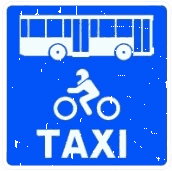 S-51a
S-51a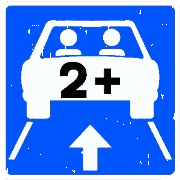 S-51b
S-51bS-51a reserves the lane for the vehicle types whose pictograms it carries; others may use it only where the line is broken, and only for manoeuvres other than stopping, parking, turning round or overtaking. S-51b reserves it for high-occupancy vehicles, with the number of occupants set by the authority managing the road.
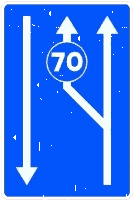 S-50a
S-50a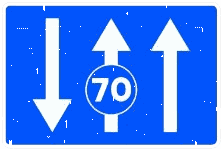 S-50d
S-50dS-50a announces a new lane on the left, reserved for those travelling at least at the minimum speed. At S-50d no lane is added: the reservation applies to the existing lane under the minimum-speed sign.
42 signs
S-50a
Lanes reserved by signed speed
On a two-way carriageway, an extra lane opens on the left that may only be used by vehicles travelling at or above the speed shown, though where conditions allow they must keep to the right-hand lane. The minimum-speed requirement ends at an R-506 sign or the relevant S-52 sign.
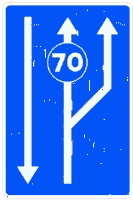
S-50b
Lanes reserved by signed speed
On a two-way carriageway, an extra lane opens on the right. The lane under the minimum-speed sign may only be used by vehicles travelling at or above the speed shown, though where conditions allow they must keep to the right-hand lane. The minimum-speed requirement ends at an R-506 sign or the relevant S-52 sign.
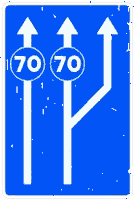
S-50c
Lanes reserved by signed speed
On a one-way carriageway, an extra lane opens on the right. The lanes under the minimum-speed sign may only be used by vehicles travelling at or above the speed shown, though where conditions allow they must keep to the right-hand lane. The minimum-speed requirement ends at an R-506 sign or the relevant S-52 sign.
S-50d
Lanes reserved by signed speed
On a two-way carriageway, the lane under the minimum-speed sign may only be used by vehicles travelling at or above the speed shown, though where conditions allow they must keep to the right-hand lane. The minimum-speed requirement ends at an R-506 sign or the relevant S-52 sign.
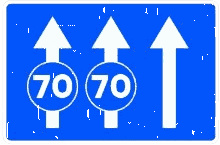
S-50e
Lanes reserved by signed speed
On a one-way carriageway, the lanes under the minimum-speed signs may only be used by vehicles travelling at or above the speed shown, though where conditions allow they must keep to the right-hand lane. The minimum-speed requirement ends at an R-506 sign or the relevant S-52 sign.
S-51a
Lane reserved for specific vehicles
A lane for the exclusive use of one or more particular vehicle types — buses, motorcycles, three-wheelers treated as motorcycles, taxis, cycles and so on. The sign carries their pictogram. Where the line marking the lane is broken, other vehicles may use the lane only for a manoeuvre other than stopping, parking, making a U-turn or overtaking, and must always give way to the vehicles the lane is reserved for.
S-51b
High-occupancy vehicle (HOV) lane
One or more lanes for the exclusive use of high-occupancy vehicles. The image gives the number of people from which occupancy counts as high, as set by the competent authority. If the lanes are also reserved for other specific vehicle types, their images may be combined as on sign S-51a.
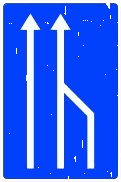
S-52
Lane ends
On a one-way carriageway with three lanes, the right-hand lane disappears and you must change lane.
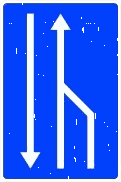
S-52a
Lane ends
On a two-way carriageway with two lanes in your direction, the right-hand lane disappears and you must change lane.
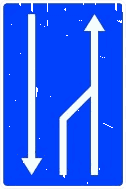
S-52b
Lane ends
On a two-way carriageway with two lanes in your direction, the left-hand lane disappears and you must change lane.
S-52c
Lane ends
On a one-way carriageway with two lanes, the right-hand lane disappears and you must change lane.
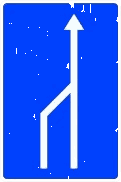
S-52d
Lane ends
On a one-way carriageway with two lanes, the left-hand lane disappears and you must change lane.
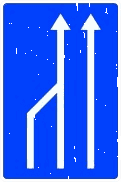
S-52e
Lane ends
On a one-way carriageway with three lanes, the left-hand lane disappears and you must change lane.
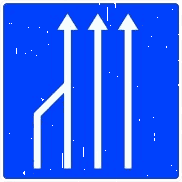
S-52f
Lane ends
On a one-way carriageway with four lanes, the left-hand lane disappears and you must change lane.
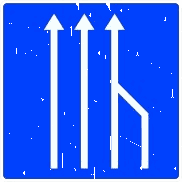
S-52g
Lane ends
On a one-way carriageway with four lanes, the right-hand lane disappears and you must change lane.
S-53
One lane becomes two
On a single-lane stretch, two lanes are about to open in the same direction.
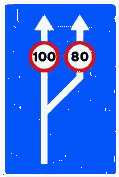
S-53a
One lane becomes two, with a speed limit for each
On a single-lane stretch, two lanes are about to open in the same direction. It also gives the maximum speed allowed in each.
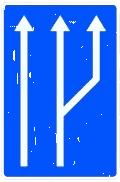
S-53b
Two lanes become three
On a stretch with two lanes in one direction, three lanes are about to open in the same direction.
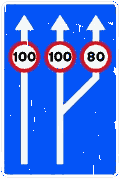
S-53c
Two lanes become three, with a speed limit for each
On a stretch with two lanes in one direction, three lanes are about to open in the same direction. It also gives the maximum speed allowed in each.
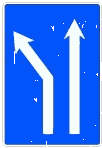
S-60a
Left fork on a two-lane carriageway
On a carriageway with two lanes in the same direction, the left-hand lane forks off in another direction.
S-60b
Right fork on a two-lane carriageway
On a carriageway with two lanes in the same direction, the right-hand lane forks off in another direction.
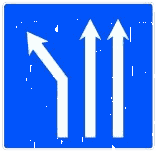
S-61a
Left fork on a three-lane carriageway
On a carriageway with three lanes in the same direction, the left-hand lane forks off in another direction.
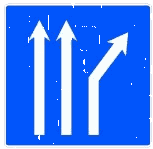
S-61b
Right fork on a three-lane carriageway
On a carriageway with three lanes in the same direction, the right-hand lane forks off in another direction.
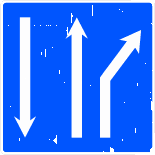
S-61c
Right fork, two lanes your way and one oncoming
On a two-way carriageway with two lanes in your direction, the right-hand lane forks off in another direction.
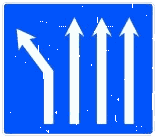
S-62a
Left fork on a four-lane carriageway
On a carriageway with four lanes in the same direction, the left-hand lane forks off in another direction.
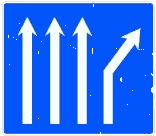
S-62b
Right fork on a four-lane carriageway
On a carriageway with four lanes in the same direction, the right-hand lane forks off in another direction.
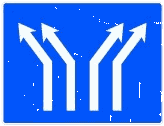
S-63a
Fork on a four-lane carriageway
On a carriageway with four lanes in the same direction, the road forks with two lanes going left and two going right.
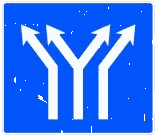
S-63b
Fork on a three-lane carriageway
On a carriageway with three lanes in the same direction, the middle lane splits and the four resulting lanes divide, two to the left and two to the right.
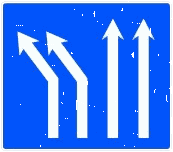
S-63c
Two left lanes fork off, four-lane carriageway
On a carriageway with four lanes in the same direction, the two left-hand lanes fork off in another direction.
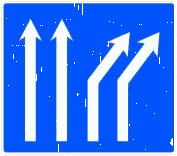
S-63d
Two right lanes fork off, four-lane carriageway
On a carriageway with four lanes in the same direction, the two right-hand lanes fork off in another direction.
S-64a
Compulsory cycle lane beside a one-way carriageway
On a one-way carriageway, cyclists must use the lane under the sign and all other road users are barred from it. The arrows show how many lanes there are.
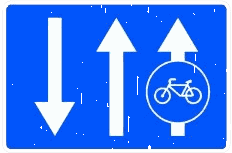
S-64b
Compulsory cycle lane beside a two-way carriageway
On a two-way carriageway, cyclists must use the lane under the sign and all other road users are barred from it. The arrows show how many lanes there are and their direction of travel.
S-65a
Cycle lane beside a one-way carriageway
On a one-way carriageway, the lane under the sign is reserved for cycles and all other road users are barred from it. The arrows show how many lanes there are.
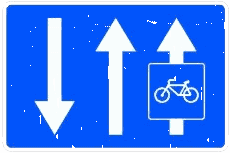
S-65b
Cycle lane beside a two-way carriageway
On a two-way carriageway, the lane under the sign is reserved for cycles and all other road users are barred from it. The arrows show how many lanes there are and their direction of travel.
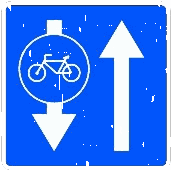
S-66
Contraflow cycle lane
A compulsory cycle lane whose direction of travel is the opposite of the lane next to it.
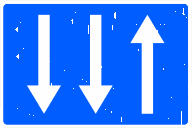
S-68
One lane your way, two oncoming
On a two-way carriageway, you have a single lane while the opposite direction has two. A supplementary S-810 panel gives how far this layout runs.
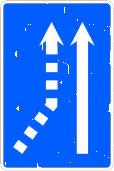
S-70a
Lane merges from the left, single-lane carriageway
On a single-lane carriageway, a lane merges in from the left.
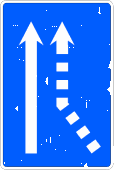
S-70b
Lane merges from the right, single-lane carriageway
On a single-lane carriageway, a lane merges in from the right.
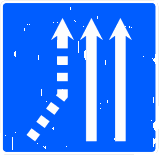
S-71a
Lane merges from the left, two-lane carriageway
On a carriageway with two lanes in the same direction, a lane merges in from the left.
S-71b
Lane merges from the right, two-lane carriageway
On a carriageway with two lanes in the same direction, a lane merges in from the right.
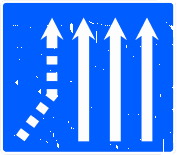
S-72a
Lane merges from the left, three-lane carriageway
On a carriageway with three lanes in the same direction, a lane merges in from the left.
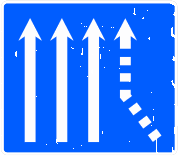
S-72b
Lane merges from the right, three-lane carriageway
On a carriageway with three lanes in the same direction, a lane merges in from the right.
The definitions in the list follow the regulation's Spanish text. The introduction and the comparisons are ours.
Source: Reglamento General de Circulación — Anexo I, apartado 5: Catálogo oficial de señales de la circulación y marcas viales (Catálogo de señales verticales, tomo I) · Anexo I, apartado 5 (Catálogo de señales verticales de circulación, tomo I)
Keep going
Other sign categories
- Danger warning signs58
- Priority signs6
- Entry prohibition signs21
- Passage restriction signs6
- Other prohibition and restriction signs20
- Obligation signs33
- End of prohibition, restriction or obligation signs17
- General indication signs70
- Service signs34
- Advance direction signs27
- Direction signs28
- Road identification signs7
- Location signs25
- Confirmation signs3
- Urban-specific signs8
- Supplementary panels24
- Other signs26
Get the app
Start on your phone
Everything above lives in the app for iPhone and Android. Free to start — no card needed.
Spanish driving theory, in your language
Available for iOS 15+ and Android 8+.