Catalogue section 3.7
End of prohibition, restriction or obligation signs (R-500–R-516)
They mark where an earlier prohibition, restriction or duty stops applying.
How to recognise them: A circle with a white background crossed by a slanted grey band over the symbol it cancels.
How this group is laid out
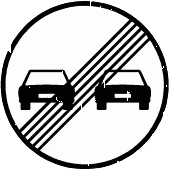
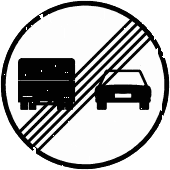
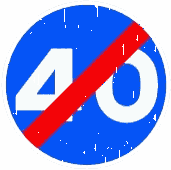
None of these signs sets a rule: they mark the point from which an earlier one stops applying, and each definition says which. R-501 lifts the speed limit of an R-301; R-502 and R-503 the overtaking bans of R-305 and, for lorries, R-306; R-504 the restricted parking zone of R-309. The rest close a duty: the minimum speed of R-411 (R-506), the compulsory carriageways for motor vehicles, motorcycles or lorries (R-507 to R-509), and the reserved or compulsory ways and tracks for cycles, mopeds, animal-drawn vehicles, riders, pedestrians, tractors and personal mobility vehicles (R-505 and R-510 to R-516).
R-500 is different. It does not cancel one particular sign, but every specific prohibition that earlier signs placed on moving vehicles. That is why it appears in other definitions: R-301 and R-305 stop applying at the next sign ending their own prohibition or at an "End of all restrictions" sign.
How to tell them apart
Signs in this group that look alike, and what separates them according to their definitions.
 R-500
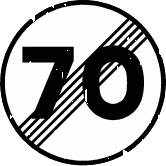 R-501
R-501 cancels just one earlier maximum-speed sign. R-500 lifts every specific prohibition on moving vehicles, the speed limit included.
 R-502
 R-503
R-502 ends the overtaking ban for everyone; R-503 only the one that applied to lorries.
- R-501
 R-506
R-501 ends a maximum speed and R-506 a minimum speed. That is not the only way the minimum ends: according to R-411, a different minimum-speed sign or a maximum-speed sign of the same or a lower value also ends it.
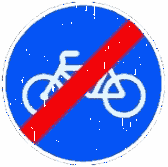 R-505
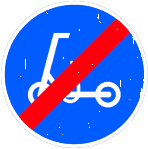 R-515
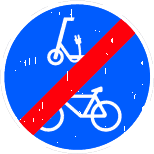 R-516
R-505 ends the reserved and compulsory way for cycles, R-515 the one for personal mobility vehicles, and R-516 the one they shared.
17 signs
R-500
End of all restrictions
From here, every specific restriction imposed on moving vehicles by earlier prohibition signs stops applying.
R-501
End of speed limit
From here, the earlier maximum-speed sign stops applying.
R-502
End of no-overtaking
From here, the earlier no-overtaking sign stops applying.
R-503
End of no-overtaking for lorries
From here, the earlier no-overtaking sign for lorries stops applying.

R-504
End of time-limited parking zone
From here, the earlier time-limited parking zone sign stops applying.
R-505
End of cycle track
From here, the earlier compulsory cycle-track sign stops applying.
R-506
End of minimum speed
From here, the earlier minimum-speed sign stops applying.
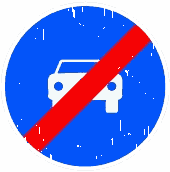
R-507
End of compulsory carriageway for automobiles, except two-wheeled motorcycles
From here, the earlier sign making the carriageway compulsory for automobiles — other than two-wheeled motorcycles and three-wheelers treated as motorcycles — stops applying.
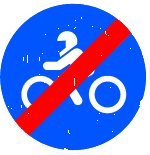
R-508
End of compulsory carriageway for two-wheeled motorcycles
From here, the earlier sign making the carriageway compulsory for two-wheeled motorcycles and three-wheelers treated as motorcycles stops applying.
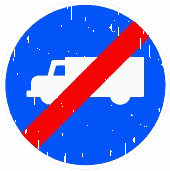
R-509
End of compulsory carriageway for lorries, tractor units and vans
From here, the earlier sign making the carriageway compulsory for lorries, tractor units and vans stops applying.
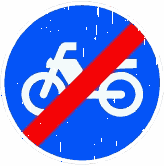
R-510
End of moped track
From here, the earlier compulsory moped-track sign stops applying.
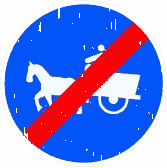
R-511
End of track for animal-drawn vehicles
From here, the earlier compulsory track sign for animal-drawn vehicles stops applying.
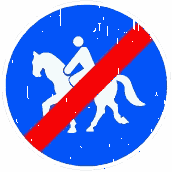
R-512
End of bridleway
From here, the earlier sign reserving the track for ridden animals stops applying.
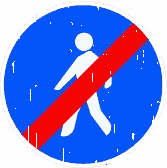
R-513
End of footpath
From here, the earlier sign reserving the path for pedestrians stops applying.

R-514
End of track for tractors
From here, the earlier compulsory track sign for tractors stops applying.
R-515
End of track for personal mobility vehicles
From here, the earlier sign reserving the way for personal mobility vehicles stops applying.
R-516
End of track for cycles and personal mobility vehicles
From here, the earlier sign reserving the way for cycles and personal mobility vehicles stops applying.
The definitions in the list follow the regulation's Spanish text. The introduction and the comparisons are ours.
Source: Reglamento General de Circulación — Anexo I, apartado 5: Catálogo oficial de señales de la circulación y marcas viales (Catálogo de señales verticales, tomo I) · Anexo I, apartado 5 (Catálogo de señales verticales de circulación, tomo I)
Keep going
Other sign categories
- Danger warning signs58
- Priority signs6
- Entry prohibition signs21
- Passage restriction signs6
- Other prohibition and restriction signs20
- Obligation signs33
- General indication signs70
- Lane signs42
- Service signs34
- Advance direction signs27
- Direction signs28
- Road identification signs7
- Location signs25
- Confirmation signs3
- Urban-specific signs8
- Supplementary panels24
- Other signs26
Get the app
Start on your phone
Everything above lives in the app for iPhone and Android. Free to start — no card needed.
Spanish driving theory, in your language
Available for iOS 15+ and Android 8+.