Catalogue section 3.3
Entry prohibition signs (R-100–R-120)
They bar particular vehicles or road users from going past the point where they stand.
How to recognise them: A circle with a red border and a white background, carrying the symbol of whoever may not pass.
How this group is laid out
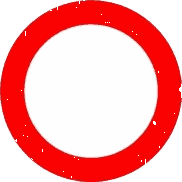
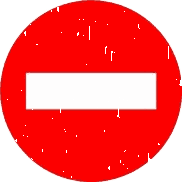
Each sign in this group shuts out someone in particular, and the regulation says exactly whom it binds: whoever meets it head-on in their direction of travel, from the point where it stands. R-100 and R-101 are the broadest. The first prohibits traffic of every kind of vehicle in both directions; the second prohibits entry.
From there, the symbol names who is barred. Some signs pick by type of vehicle: motor vehicles (R-102, and R-103, which still lets two-wheeled motorcycles through), motorcycles (R-104), mopeds (R-105), agricultural vehicles (R-111), vehicles towing a trailer with more than one axle (R-112), animal-drawn vehicles (R-113), cycles (R-114) or personal mobility vehicles (R-118 and R-119). Others look at the load: goods in general (R-106) or above a given weight (R-107), dangerous goods (R-108), explosive or flammable goods (R-109) and substances that can pollute water (R-110). There are also signs for people not driving a vehicle at all: handcarts, pedestrians and ridden animals, R-115 to R-117. R-120 depends on the vehicle's environmental badge, with the conditions on an S-860 panel or a board.
How to tell them apart
Signs in this group that look alike, and what separates them according to their definitions.
 R-100
 R-101
R-100 prohibits every kind of vehicle from travelling in either direction; R-101 prohibits every kind of vehicle from entering. Like every sign in this group, they bind whoever meets them head-on, from the point where they stand.
 R-102
 R-103
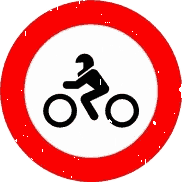 R-104
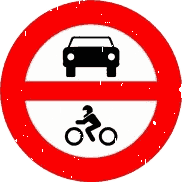
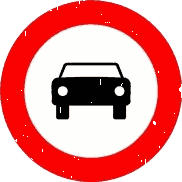
R-102 bars all motor vehicles. So does R-103, but it lets through two-wheeled motorcycles and three-wheelers treated as motorcycles, which are exactly the vehicles R-104 bars.
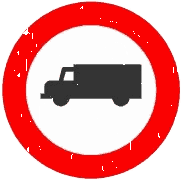 R-106
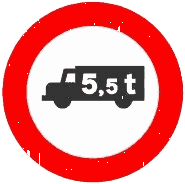 R-107
R-106 shuts out lorries, tractor units and vans, whatever their weight. R-107 only shuts out those whose maximum authorised weight is above the figure on the sign, even when they are running empty.
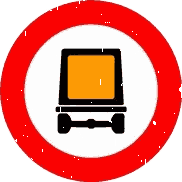 R-108
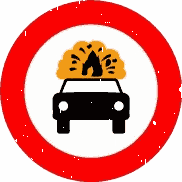 R-109
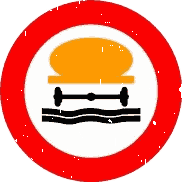 R-110
R-108 covers all dangerous goods that must be placarded; R-109 only explosive or readily flammable goods. R-110 looks at something else: more than 1,000 litres of substances that can pollute water.
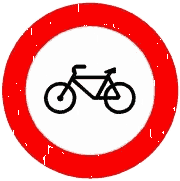 R-114
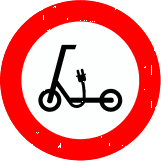 R-118
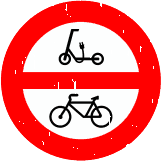 R-119
R-114 bars cycles and R-118 personal mobility vehicles. R-119 combines both bans in a single sign.
21 signs
R-100
No traffic
No vehicles of any kind may use this road, in either direction.
R-101
No entry
No vehicle of any kind may enter.
R-102
No motor vehicles
Motor vehicles may not enter.
R-103
No motor vehicles except two-wheeled motorcycles
Motor vehicles may not enter. Two-wheeled motorcycles and three-wheelers treated as motorcycles are still allowed.
R-104
No motorcycles
Motorcycles and three-wheelers treated as motorcycles may not enter.
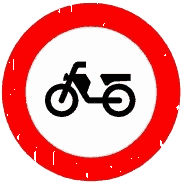
R-105
No mopeds
Mopeds may not enter. Vehicles for people with reduced mobility are also barred.
R-106
No goods vehicles
Goods vehicles may not enter — lorries, tractor units and vans, whatever their mass.
R-107
No goods vehicles with an MAM above the figure shown
Goods vehicles — lorries, tractor units and vans — whose maximum authorised mass (MAM) is above the figure shown may not enter. The ban applies even when they are running empty.
R-108
No dangerous goods
Vehicles carrying dangerous goods that must be placarded under the relevant rules may not enter.
R-109
No explosive or flammable goods
Vehicles carrying explosive or readily flammable goods that must be placarded under the relevant rules may not enter.
R-110
No water-polluting loads
Vehicles carrying more than 1,000 litres of substances that can pollute water may not enter.
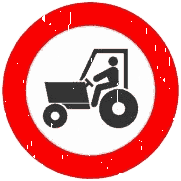
R-111
No agricultural motor vehicles
Tractors and other self-propelled agricultural machinery may not enter.
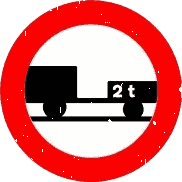
R-112
No motor vehicles with a trailer, except single-axle trailers
Motor vehicles towing a trailer may not enter, unless the trailer has a single axle. A tonnage figure on the trailer symbol or on a supplementary plate means the ban applies only when the trailer's maximum authorised mass (MAM) is above that figure.
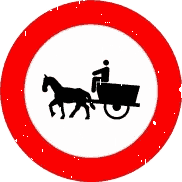
R-113
No animal-drawn vehicles
Animal-drawn vehicles may not enter.
R-114
No cycles
Cycles may not enter.
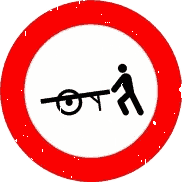
R-115
No handcarts
Handcarts may not enter.
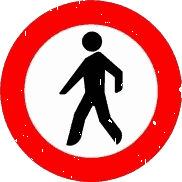
R-116
No pedestrians
Pedestrians may not enter.
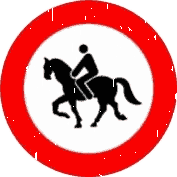
R-117
No ridden animals
Ridden animals may not enter.
R-118
No personal mobility vehicles
Personal mobility vehicles may not enter.
R-119
No cycles or personal mobility vehicles
Cycles and personal mobility vehicles may not enter.
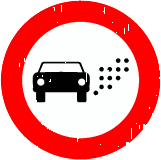
R-120
No entry by environmental badge or other criteria
Vehicles may not enter depending on their environmental badge or other environmental criteria. The conditions appear on an S-860 supplementary panel or on a board containing the sign, referring where relevant to each vehicle's badge classification.
The definitions in the list follow the regulation's Spanish text. The introduction and the comparisons are ours.
Source: Reglamento General de Circulación — Anexo I, apartado 5: Catálogo oficial de señales de la circulación y marcas viales (Catálogo de señales verticales, tomo I) · Anexo I, apartado 5 (Catálogo de señales verticales de circulación, tomo I)
Keep going
Other sign categories
- Danger warning signs58
- Priority signs6
- Passage restriction signs6
- Other prohibition and restriction signs20
- Obligation signs33
- End of prohibition, restriction or obligation signs17
- General indication signs70
- Lane signs42
- Service signs34
- Advance direction signs27
- Direction signs28
- Road identification signs7
- Location signs25
- Confirmation signs3
- Urban-specific signs8
- Supplementary panels24
- Other signs26
Get the app
Start on your phone
Everything above lives in the app for iPhone and Android. Free to start — no card needed.
Spanish driving theory, in your language
Available for iOS 15+ and Android 8+.