
S-900
Fire risk
Warns of the danger of lighting a fire.
Catalogue section 3.18
Warnings and information that do not fit the catalogue's other families.
How to recognise them: A rectangular plate carrying the symbol or wording of what it warns of or tells you.
Whatever fits no other family in the catalogue ends up here, and it falls into themes. One is the border: S-920 says you have entered Spain by road from another country, S-930 names the country the road is heading for, with the distance to the border, and S-940 sums up Spain's general speed limits by class of road and in urban areas. Another is emergencies: fire extinguishers and telephones (S-910, S-960 and S-970), and emergency exits, either adjacent (S-980a and S-980b) or further on, with the direction and the distance left to go (S-990a and S-990b).
The S-991 series warns of enforcement devices: for speed by type of road, for passing a red light or a STOP, for the minimum gap between vehicles, and for speed from the air, such as a helicopter or a drone. The S-992 series turns the gap between vehicles into something you can count: the chevron road markings, or the light beacons in fog, to leave between you and the vehicle ahead. The group ends with fire risk (S-900), the radio frequency carrying road information (S-950) and S-993, which warns of the risk of rear-end collisions on uphill motorways or autovías, where lorries travel considerably more slowly than cars.
Signs in this group that look alike, and what separates them according to their definitions.
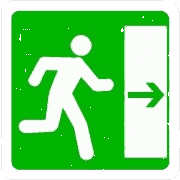 S-980a
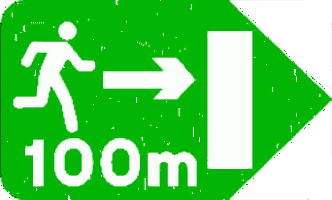 S-990a
S-980a shows the position of the nearest emergency exit, next to the sign. S-990a shows the direction it lies in and the distance left to reach it.
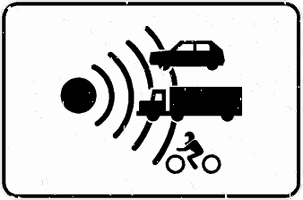 S-991a
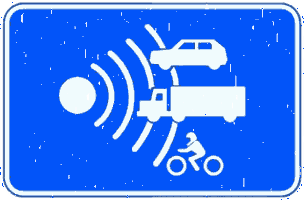 S-991b
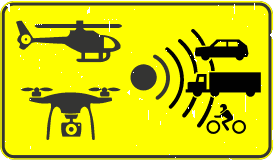 S-991g
S-991a and S-991b warn of a speed check at a point or along a stretch, the first on a conventional or multi-lane road and the second on a motorway or autovía. S-991g warns of possible speed checks from the air, by helicopter or drone.
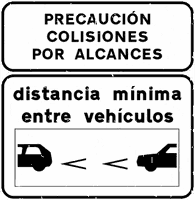 S-992a
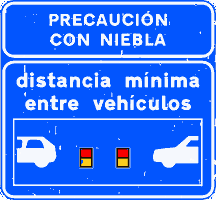 S-992e
S-992a tells you how many chevron road markings to leave between you and the vehicle ahead on a stretch with frequent rear-end collisions. S-992e counts light beacons instead, on stretches where fog often cuts visibility.
 S-910
 S-960
 S-970
S-910 marks a fire extinguisher, S-960 an emergency telephone, and S-970 both together.
 S-920
 S-930
S-920 tells you that you have entered Spain by a road coming from another country. S-930 names the country the road is heading for, with the distance to the border.
26 signs
S-900
Warns of the danger of lighting a fire.
S-910
Marks the position of a fire extinguisher.
S-920
Shows that you have entered Spanish territory on a road coming from another country.
S-930
Gives the name of the country the road leads to. The figure at the bottom gives the distance to the border.
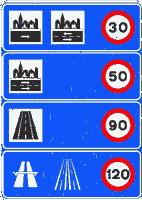
S-940
Gives the general speed limits on the various classes of road and in built-up areas in Spain.
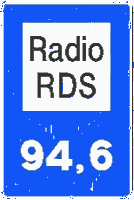
S-950
Gives the frequency to tune the radio to in order to receive information.
S-960
Marks the position of an emergency telephone.
S-970
Marks the position of a fire extinguisher and an emergency telephone.
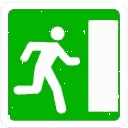
S-980
Marks the position of an emergency exit.
S-980a
Gives the position of the nearest emergency exit.
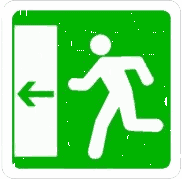
S-980b
Gives the position of the nearest emergency exit.
S-990a
Gives the direction of the nearest emergency exit and how far is left to reach it.
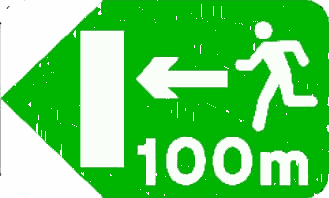
S-990b
Gives the direction of the nearest emergency exit and how far is left to reach it.
S-991a
Shows that there is a speed enforcement device at a point on, or along a stretch of, a conventional or multi-lane road. It may include an R-301 sign with the relevant speed, and panels above or below may add further information.
S-991b
Shows that there is a speed enforcement device at a point on, or along a stretch of, a motorway or dual carriageway. It may include an R-301 sign with the relevant speed, and panels above or below may add further information.
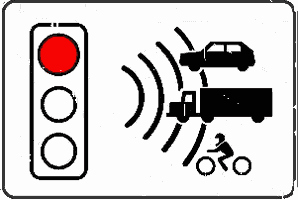
S-991c
Shows that there is a device enforcing the red traffic light. Panels above or below may add further information.
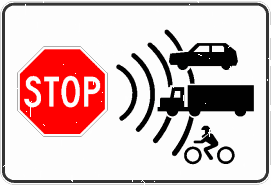
S-991d
Shows that there is a device enforcing the STOP sign. Panels above or below may add further information.
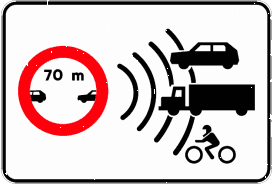
S-991e
Shows that there is a device enforcing the minimum gap between vehicles at a point on, or along a stretch of, a conventional or multi-lane road. Panels above or below may add further information.
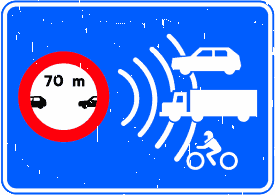
S-991f
Shows that there is a device enforcing the minimum gap between vehicles at a point on, or along a stretch of, a motorway or dual carriageway. Panels above or below may add further information.
S-991g
Shows that speed may be enforced from the air along this stretch, by helicopter or drone. Where such enforcement targets one kind of vehicle, the sign may carry only that vehicle's pictogram.
S-992a
On a stretch of conventional or multi-lane road where rear-end collisions are frequent, gives the number of chevron road markings a driver must leave between their vehicle and the one in front.
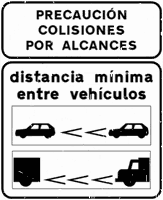
S-992b
Gives the number of chevron road markings a driver must leave between their vehicle and the one in front inside a tunnel on a conventional or multi-lane road.
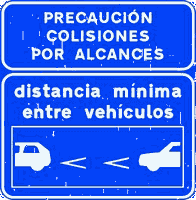
S-992c
On a stretch of motorway or dual carriageway where rear-end collisions are frequent, gives the number of chevron road markings a driver must leave between their vehicle and the one in front.
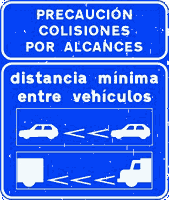
S-992d
Gives the number of chevron road markings a driver must leave between their vehicle and the one in front inside a tunnel on a motorway or dual carriageway.
S-992e
On a stretch where visibility is often lost to fog, gives the number of light beacons a driver must leave between their vehicle and the one in front.
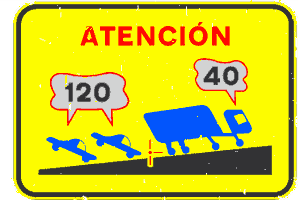
S-993
Warns of the risk of rear-end collisions on a stretch of motorway or dual carriageway, because the climb makes lorries travel appreciably slower than cars.
The definitions in the list follow the regulation's Spanish text. The introduction and the comparisons are ours.
Source: Reglamento General de Circulación — Anexo I, apartado 5: Catálogo oficial de señales de la circulación y marcas viales (Catálogo de señales verticales, tomo I) · Anexo I, apartado 5 (Catálogo de señales verticales de circulación, tomo I)
Keep going
Get the app
Everything above lives in the app for iPhone and Android. Free to start — no card needed.
Spanish driving theory, in your language
Available for iOS 15+ and Android 8+.