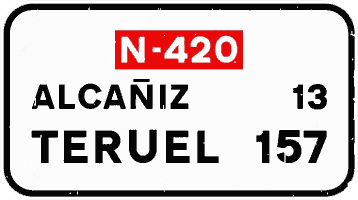
S-600
Confirmation of towns on a conventional or multi-lane road
On a conventional or multi-lane road, gives the names of towns on that route and how far each is in kilometres.
Catalogue section 3.15
They remind you of the road's reference destinations and how far each one is.
How to recognise them: A rectangular board listing destinations with their distances.
Confirmation signs repeat, as you drive, where the road leads. Under the regulation they remind you of its direction when the authorities see a need, for example on leaving major towns, and any distances go after each place's name. S-600 and S-602 do exactly that, listing towns on the route with the kilometres to each; the first stands on a conventional or multi-lane road, the second on a motorway or autovía.
S-603 combines two jobs. It names provincial capitals that are not beside the road, each with its distance and the box of the motorway or autovía that leads there, and its upper panels add the exit number and how far off that exit is. It confirms and gives advance notice at once, as its full name says: "Supplementary confirmation with advance notice of an exit".
Signs in this group that look alike, and what separates them according to their definitions.
S-600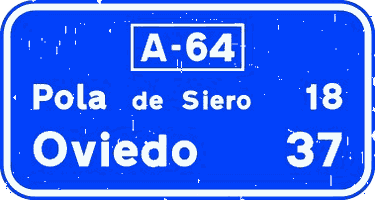 S-602
Both give the names of towns on the route and their distances in kilometres. S-600 is used on a conventional or multi-lane road; S-602 on a motorway or autovía.
S-602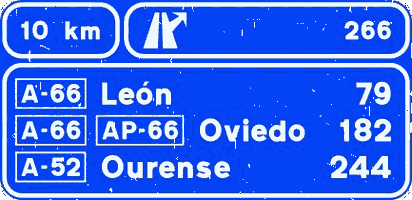 S-603
S-602 confirms towns on the route itself. S-603 names provincial capitals that are not on the motorway or autovía, with the boxes of the roads that lead to them.
S-600S-602S-603Only S-603 gives details of an exit: its number and the distance to it, on the upper panels. S-600 and S-602 keep to towns and distances.
3 signs
S-600
On a conventional or multi-lane road, gives the names of towns on that route and how far each is in kilometres.
S-602
On a motorway or dual carriageway, gives the names of towns on that route and how far each is in kilometres.
S-603
On a motorway or dual carriageway, gives the names of provincial capitals not on the road you are driving and how far each is in kilometres, together with the identifying boxes of the motorways or dual carriageways that reach them. The upper panels also give the exit number and the distance to that exit.
The definitions in the list follow the regulation's Spanish text. The introduction and the comparisons are ours.
Source: Reglamento General de Circulación — Anexo I, apartado 5: Catálogo oficial de señales de la circulación y marcas viales (Catálogo de señales verticales, tomo I) · Anexo I, apartado 5 (Catálogo de señales verticales de circulación, tomo I)
Keep going
Get the app
Everything above lives in the app for iPhone and Android. Free to start — no card needed.
Spanish driving theory, in your language
Available for iOS 15+ and Android 8+.