Catalogue section 3.2
Priority signs (R-1–R-6)
They set special priority rules at junctions and narrow sections.
How to recognise them: The shape varies with the sign: an inverted triangle, a red octagon or a diamond, according to the rule it imposes.
How this group is laid out
This group settles who goes first where the general rule is not enough, and it does so in the two places the regulation names: junctions and narrow sections. At a junction, R-1 requires you to give way to vehicles on the road you are approaching or in the lane you want to join. R-2 requires the same after stopping: at the stop line or, if there is none, just before the junction, and again further on if you cannot see well enough from there. R-3 tells you that the carriageway you are on has priority at junctions, and R-4 announces the point where it loses it. Under R-3, the S-850 to S-853 panels show the priority route.
On a narrow section the pair is R-5 and R-6. With R-5 you may not enter until you can get through without forcing oncoming vehicles to stop; R-6 says the opposite, that on the narrow section ahead priority is yours. The regulation also counts some danger signs as priority signs: P-1 to P-1d, P-2, P-6, P-7 and P-8.
How to tell them apart
Signs in this group that look alike, and what separates them according to their definitions.
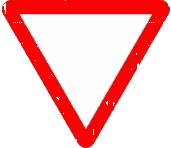 R-1
 R-2
Both require you to give way at the next junction. R-2 also requires you to stop at the stop line or, if there is none, immediately before the junction, and to stop again if you still cannot see enough from there.
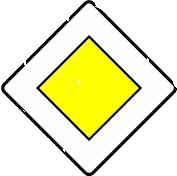 R-3
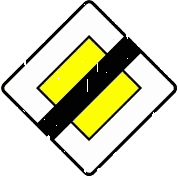 R-4
R-3 tells you that the carriageway you are on has priority at junctions over the other carriageway. R-4 announces that the point where that priority ends is coming up.
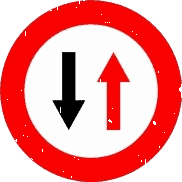 R-5
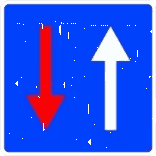 R-6
At R-5 you give way: you do not enter the narrow section while you would force oncoming traffic to stop. At R-6 priority over vehicles coming the other way is yours.
6 signs
R-1
Give way
Give way at the next junction to vehicles on the road you are approaching, or in the lane you want to join.
R-2
Stop
Stop completely at the stop line, or immediately before the junction if there is no line, then give way to traffic on the road you are approaching. If you still cannot see well enough from where you stopped, stop again where you can see, without endangering anyone.
R-3
Priority road
Tells you that your road has priority at junctions over traffic on, or coming from, the crossing road.
R-4
End of priority
Your road is about to lose the priority it had over the crossing road.
R-5
Give way to oncoming traffic
Do not enter the narrow section unless you can get through without forcing oncoming vehicles to stop.
R-6
Priority over oncoming traffic
At the narrow section ahead you have priority over vehicles coming the other way.
The definitions in the list follow the regulation's Spanish text. The introduction and the comparisons are ours.
Source: Reglamento General de Circulación — Anexo I, apartado 5: Catálogo oficial de señales de la circulación y marcas viales (Catálogo de señales verticales, tomo I) · Anexo I, apartado 5 (Catálogo de señales verticales de circulación, tomo I)
Keep going
Other sign categories
- Danger warning signs58
- Entry prohibition signs21
- Passage restriction signs6
- Other prohibition and restriction signs20
- Obligation signs33
- End of prohibition, restriction or obligation signs17
- General indication signs70
- Lane signs42
- Service signs34
- Advance direction signs27
- Direction signs28
- Road identification signs7
- Location signs25
- Confirmation signs3
- Urban-specific signs8
- Supplementary panels24
- Other signs26
Get the app
Start on your phone
Everything above lives in the app for iPhone and Android. Free to start — no card needed.
Spanish driving theory, in your language
Available for iOS 15+ and Android 8+.