Catalogue section 3.1
Danger warning signs (P-1–P-50)
They tell you a hazard that is hard to spot in time is coming up, and what kind it is, so you can adjust your driving.
How to recognise them: An equilateral triangle pointing up, with a red border and a white background carrying a black symbol.
How this group is laid out
The definitions in this group nearly always follow one pattern, "danger from the approach of…", and what changes is the ending: a junction, a bend, a level crossing, a stretch with loose animals, or chippings thrown up by passing vehicles. The codes group the warnings by stem. The P-1 signs announce a junction whose users must give way: the letters a to d say where that road comes in from, and P-1e warns of a stretch with several direct accesses. P-2 warns of the opposite, a junction where the general priority rule applies. The regulation also counts some of them as priority signs while they remain danger signs: P-1 and P-1a to P-1d, P-2, P-6 for trams, and P-7 and P-8 for level crossings.
Level crossings have a series of their own. P-7 and P-8 separate crossings with barriers from those without, P-11 marks an unbarriered crossing immediately ahead, and the P-9 (right-hand) and P-10 (left-hand) markers count down the distance; P-9a and P-10a always come with a P-5, P-7, P-8 or P-27. Other letters only change the side, as with the P-13 and P-14 bends, or narrow down the hazard, as with P-24a, where a large share of the wild animals are wild boar. For anything no other sign describes, there is P-50.
How to tell them apart
Signs in this group that look alike, and what separates them according to their definitions.
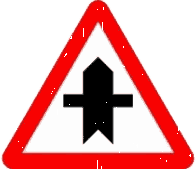 P-1
P-1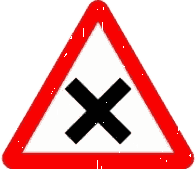 P-2
P-2At P-1, traffic coming from the other road must give way. At P-2 neither road has priority and the general priority rule applies. Both are danger signs, and the regulation counts both as priority signs too.
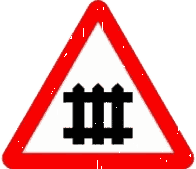 P-7
P-7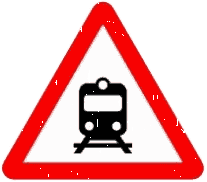 P-8
P-8 P-11
P-11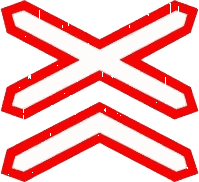 P-11a
P-11aP-7 announces a level crossing with barriers or half-barriers, and P-8 one without. P-11 no longer announces anything: it marks an unbarriered crossing right there, and P-11a adds that it crosses more than one railway track.
 P-9a
P-9a P-9c
P-9c P-10a
P-10aP-9 markers stand on the right of the carriageway and P-10 markers on the left. In both series, letter a is furthest from the level crossing, opening bridge or quay and c is closest; the a marker always comes with its danger sign.
 P-15
P-15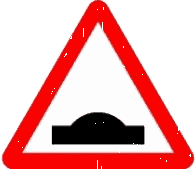 P-15a
P-15a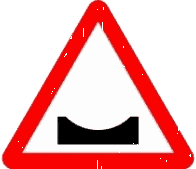 P-15b
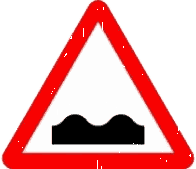
P-15bP-15 is the general one: it warns of a hump, a dip or a badly surfaced road. P-15a says that what is coming is a hump, and P-15b that it is a dip.
 P-20a
P-20a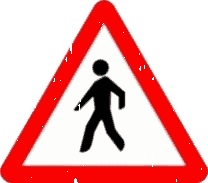 P-20b
P-20b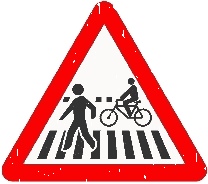 P-20c
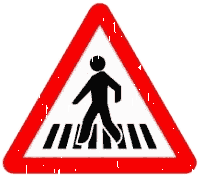
P-20cP-20a warns of one or more pedestrian crossings; P-20b of a place or stretch with heavy pedestrian traffic. P-20c is a pedestrian crossing alongside, or shared with, a cycle crossing.
 P-23
P-23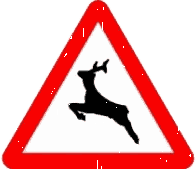 P-24
P-24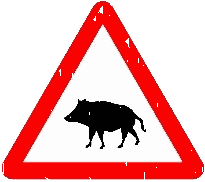 P-24a
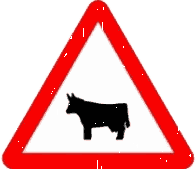
P-24aP-23 warns of domestic animals or livestock that often cross the road; P-24 of wild animals. P-24a is the same warning where a very significant share of those animals are wild boar.
58 signs
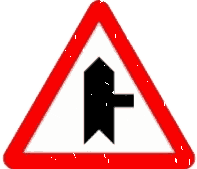
P-1
Junction with priority
A junction is coming up with a road whose users must give way to you.
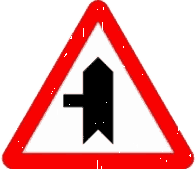
P-1a
Junction with priority over a road on the right
A junction is coming up with a road on the right whose users must give way to you.
P-1b
Junction with priority over a road on the left
A junction is coming up with a road on the left whose users must give way to you.
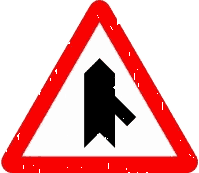
P-1c
Priority over a road joining from the right
A road joins from the right ahead, and its users must give way to you.
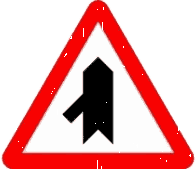
P-1d
Priority over a road joining from the left
A road joins from the left ahead, and its users must give way to you.
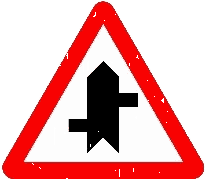
P-1e
Stretch with direct access points
A stretch ahead has several direct access points onto the road; traffic using them must give way to you.
P-2
Junction where priority is to the right
A junction is coming up where the general give-way-to-the-right rule applies.
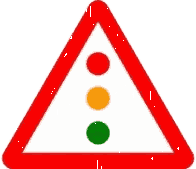
P-3
Traffic lights
An isolated junction or stretch controlled by traffic lights is coming up.
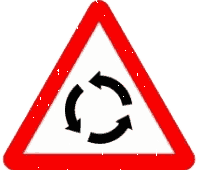
P-4
Roundabout
A roundabout is coming up, with traffic flowing the way the arrows show.
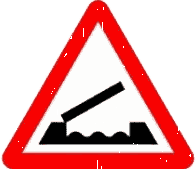
P-5
Opening bridge
A bridge ahead can be raised or swung, which temporarily interrupts traffic.
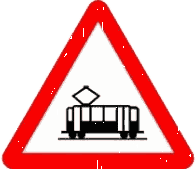
P-6
Tram crossing
A tram line crosses ahead, and the tram has priority.
P-7
Level crossing with barriers
A level crossing with barriers or half-barriers is coming up.
P-8
Level crossing without barriers
A level crossing with no barriers or half-barriers is coming up.
P-9a
Level crossing, opening bridge or quay 200 m ahead (right)
A level crossing, opening bridge or quay lies 200 m ahead. This marker stands on the right of the carriageway and always accompanies a P-5, P-7, P-8 or P-27 sign.

P-9b
Level crossing, opening bridge or quay 150 m ahead (right)
A level crossing, opening bridge or quay lies 150 m ahead. This marker stands on the right of the carriageway.
P-9c
Level crossing, opening bridge or quay 100 m ahead (right)
A level crossing, opening bridge or quay lies 100 m ahead. This marker stands on the right of the carriageway.
P-10a
Level crossing, opening bridge or quay 200 m ahead (left)
A level crossing, opening bridge or quay lies 200 m ahead. This marker stands on the left of the carriageway and always accompanies a P-5, P-7, P-8 or P-27 sign.

P-10b
Level crossing, opening bridge or quay 150 m ahead (left)
A level crossing, opening bridge or quay lies 150 m ahead. This marker stands on the left of the carriageway.

P-10c
Level crossing, opening bridge or quay 100 m ahead (left)
A level crossing, opening bridge or quay lies 100 m ahead. This marker stands on the left of the carriageway.
P-11
Level crossing without barriers, here
An unbarriered level crossing is immediately ahead.
P-11a
Multi-track level crossing without barriers, here
An unbarriered level crossing with more than one railway track is immediately ahead.
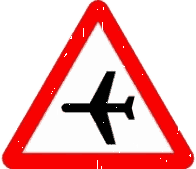
P-12
Airport
Aircraft often fly low over the road ahead and may cause sudden noise.
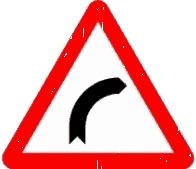
P-13a
Dangerous bend to the right
A dangerous right-hand bend is coming up.
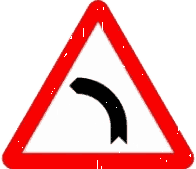
P-13b
Dangerous bend to the left
A dangerous left-hand bend is coming up.
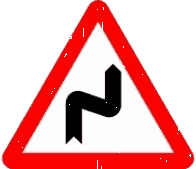
P-14a
Dangerous bends, first to the right
A series of dangerous bends close together is coming up, the first to the right.
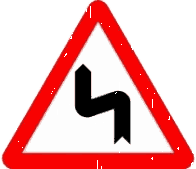
P-14b
Dangerous bends, first to the left
A series of dangerous bends close together is coming up, the first to the left.
P-15
Uneven road
A hump, dip or badly surfaced stretch of road is coming up.
P-15a
Hump
A hump in the road is coming up.
P-15b
Dip
A dip in the road is coming up.
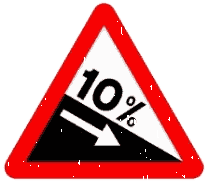
P-16a
Steep descent
A steep downhill stretch of road lies ahead. The figure gives the gradient as a percentage.
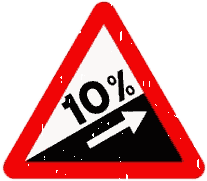
P-16b
Steep climb
A steep uphill stretch of road lies ahead. The figure gives the gradient as a percentage.
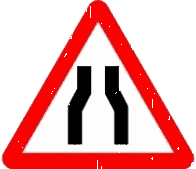
P-17
Road narrows
The carriageway narrows ahead. The sign may also be used where the hard shoulders get narrower. It is not used where the number of lanes drops but the remaining lanes and hard shoulders keep their width.
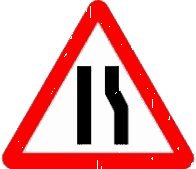
P-17a
Road narrows from the right
The carriageway narrows from the right ahead. The sign may also be used where the right hard shoulder gets narrower. It is not used where lanes are dropped on the right but the remaining lanes and hard shoulders keep their width.
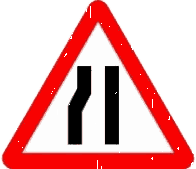
P-17b
Road narrows from the left
The carriageway narrows from the left ahead. The sign may also be used where the left hard shoulder gets narrower on a one-way carriageway. It is not used where lanes are dropped on the left but the remaining lanes and hard shoulders keep their width.
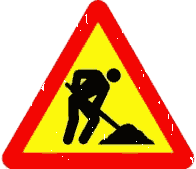
P-18
Roadworks
A stretch of road with roadworks is coming up.
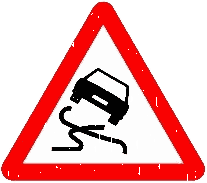
P-19
Slippery road
The surface ahead may be slippery.
P-20a
Pedestrian crossing
One or more pedestrian crossings are coming up.
P-20b
Pedestrians
A place or stretch with heavy pedestrian traffic is coming up.
P-20c
Pedestrian and cycle crossings
A pedestrian crossing alongside or shared with a cycle crossing is coming up.
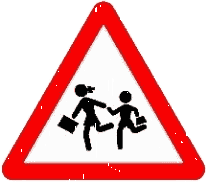
P-21a
Children
A place often used by children is coming up — a school, a playground and the like.
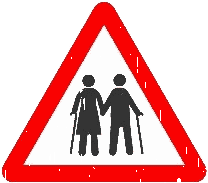
P-21b
People with mobility difficulties
A place often used by people with mobility or sensory difficulties is coming up.
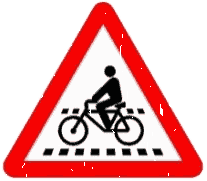
P-22a
Cycle crossing
One or more cycle crossings are coming up.
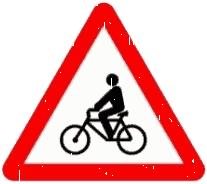
P-22b
Cyclists
A stretch with frequent cycle traffic is coming up.
P-23
Domestic animals or livestock crossing
Domestic animals or livestock often cross the road ahead.
P-24
Wild animals crossing
Wild animals often cross the road ahead.
P-24a
Wild boar crossing
Wild animals often cross the road ahead, and a large share of them are wild boar.
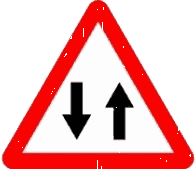
P-25
Two-way traffic
A stretch with traffic in both directions is coming up.
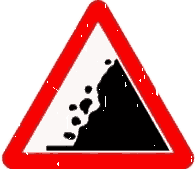
P-26
Falling rocks
A stretch with frequent rockfalls is coming up, so there may be obstacles on the carriageway.
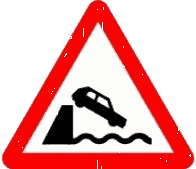
P-27
Quayside
Danger because the road runs out onto a quay or into water.
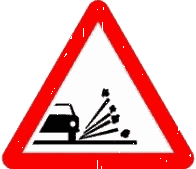
P-28
Loose chippings
On the stretch ahead, passing vehicles may throw up loose chippings.
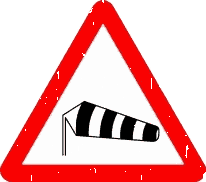
P-29
Side wind
Strong crosswinds often blow in the area ahead.
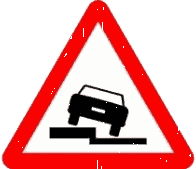
P-30
Drop at the roadside
There is a drop along the side of the road, on the side the symbol shows.
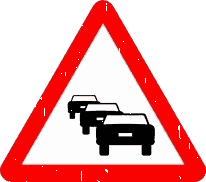
P-31
Congestion
Traffic on the stretch ahead is often stopped or held up by congestion.
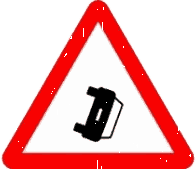
P-32
Obstruction on the carriageway
Vehicles are blocking the carriageway ahead after a breakdown, a crash or something similar.
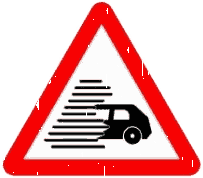
P-33
Reduced visibility
On the stretch ahead, driving is often made harder by a marked loss of visibility from fog, rain, snow, smoke and the like.
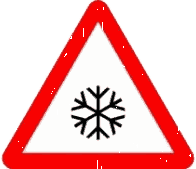
P-34
Ice or snow
The stretch ahead often has ice or snow in winter, with the hazards that brings.
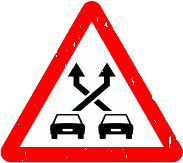
P-35
Weaving section
Between a merge and a split ahead, vehicles change lanes across each other's paths, which raises the risk of collision.

P-50
Other danger
A danger is coming up that no other sign warns of.
The definitions in the list follow the regulation's Spanish text. The introduction and the comparisons are ours.
Source: Reglamento General de Circulación — Anexo I, apartado 5: Catálogo oficial de señales de la circulación y marcas viales (Catálogo de señales verticales, tomo I) · Anexo I, apartado 5 (Catálogo de señales verticales de circulación, tomo I)
Keep going
Other sign categories
- Priority signs6
- Entry prohibition signs21
- Passage restriction signs6
- Other prohibition and restriction signs20
- Obligation signs33
- End of prohibition, restriction or obligation signs17
- General indication signs70
- Lane signs42
- Service signs34
- Advance direction signs27
- Direction signs28
- Road identification signs7
- Location signs25
- Confirmation signs3
- Urban-specific signs8
- Supplementary panels24
- Other signs26
Get the app
Start on your phone
Everything above lives in the app for iPhone and Android. Free to start — no card needed.
Spanish driving theory, in your language
Available for iOS 15+ and Android 8+.