Skip to content
ViaReady
Start preparing

Catalogue section 3.14

Location signs (S-500–S-575)

They mark a boundary between territories, or name a town, river, pass or other place.

How to recognise them: A rectangular board with the place name written on it.

How this group is laid out

Location signs put a name to the place you are passing: a town, a geographic feature the road crosses, a tunnel, the boundary between two territories, or the kilometre point you are at. One of them also changes the rules. S-500 gives the town's name and marks the point from which the rules for built-up areas apply; its upper panel is a reminder to adapt your driving to pedestrians, cyclists and other vulnerable road users, and it may add the speed limit on that road from that point. S-510 marks where those rules stop applying.

The rest help you find your way. S-540 to S-560 mark boundaries: of a province, a region, a river basin district, or a region and province at once. For tunnels there are signs that pair the road type with what they tell you: safety equipment and length (S-530 and S-531), or the duties that apply inside (S-532 and S-533). Markers give the kilometre point; the ten-kilometre markers (S-574 and S-575) only when it is a multiple of ten, and on S-575, for roads outside the state network, in the colour of the road's category.

How to tell them apart

Signs in this group that look alike, and what separates them according to their definitions.

  • S-500S-510

    S-500 marks the point from which the rules for built-up areas apply and may show the speed limit on that road; S-510 the point from which they stop applying. Both carry the town's name.

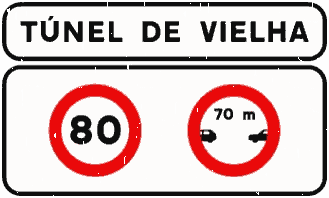
  • S-530S-532

    Both name a tunnel on a conventional or multi-lane road. S-530 tells you about its safety equipment and its length; S-532 about the particular duties that apply inside it. S-531 and S-533 are their counterparts on a motorway or autovía.

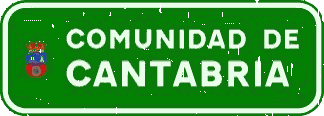
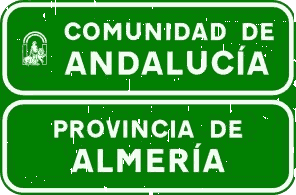
  • S-540S-550S-560

    S-540 marks entry into a province, S-550 into a region, and S-560 into a region and a province at the same time.

  • S-570S-574a

    Both give the kilometre point on a motorway or autovía. The ten-kilometre marker S-574a only shows it when that point is a multiple of ten; S-570 at any kilometre.

  • S-561S-562

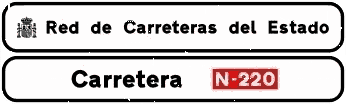
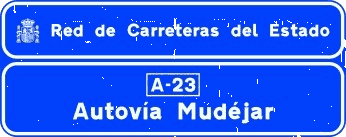
    Both give the owner, number and name of the road you are joining. If it has no name, S-561 reads "Carretera" and S-562 "Autopista" or "Autovía", followed by the road's box.

25 signs

  • Entering a built-up area

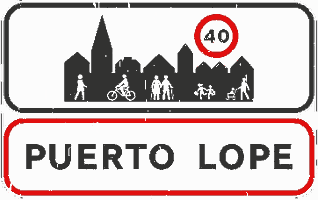
    S-500

    Entering a built-up area

    Gives the name of the built-up area you are entering, and the point from which the rules for driving in built-up areas apply. The upper panel reinforces the message that driving must be adapted where pedestrians, cyclists or other vulnerable users are about. The maximum speed allowed on that road from that point may also be given, whatever different limits other roads in the town may carry.

  • End of built-up area

    S-510

    End of built-up area

    Gives the name of the built-up area you are leaving, and the point from which the rules for driving in built-up areas stop applying.

  • Location of geographic features the road crosses

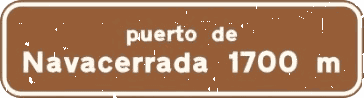
    S-520

    Location of geographic features the road crosses

    Marks the place where the road crosses a distinctive geographic feature.

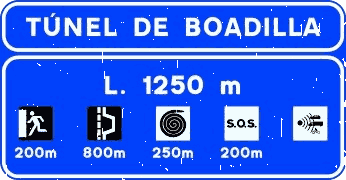
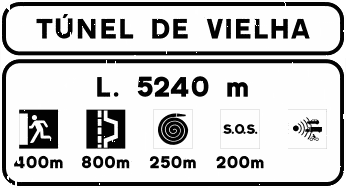
  • Location of a tunnel on a conventional or multi-lane road, with information about its safety equipment

    S-530

    Location of a tunnel on a conventional or multi-lane road, with information about its safety equipment

    Marks a tunnel on a conventional or multi-lane road, including information about its safety equipment and its length.

  • Location of a tunnel on a motorway or dual carriageway, with information about its safety equipment

    S-531

    Location of a tunnel on a motorway or dual carriageway, with information about its safety equipment

    Marks a tunnel on a motorway or dual carriageway, including information about its safety equipment and its length.

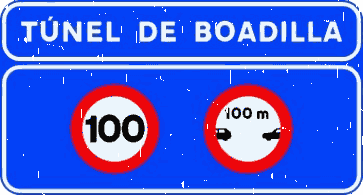
  • Location of a tunnel on a conventional or multi-lane road, with information about the particular duties that apply inside it

    S-532

    Location of a tunnel on a conventional or multi-lane road, with information about the particular duties that apply inside it

    Marks a tunnel on a conventional or multi-lane road, including information about the particular driving duties that apply inside it.

  • Location of a tunnel on a motorway or dual carriageway, with information about the particular duties that apply inside it

    S-533

    Location of a tunnel on a motorway or dual carriageway, with information about the particular duties that apply inside it

    Marks a tunnel on a motorway or dual carriageway, including information about the particular driving duties that apply inside it.

  • Provincial boundary

    S-540

    Provincial boundary

    Marks the point from which the road enters the province named.

  • Regional boundary

    S-550

    Regional boundary

    Marks the point from which the road enters the autonomous community named.

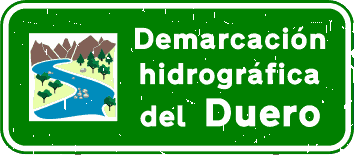
  • River-basin boundary

    S-551

    River-basin boundary

    Marks the point from which the road enters the river basin named.

  • Regional and provincial boundary

    S-560

    Regional and provincial boundary

    Marks the point from which the road enters the autonomous community and province named.

  • Authority panel on a conventional or multi-lane road

    S-561

    Authority panel on a conventional or multi-lane road

    A sign giving the ownership, number and name of the conventional or multi-lane road you are joining. If the road has no name, the panel carries the word “Carretera” followed by its identifying box.

  • Authority panel on a motorway or dual carriageway

    S-562

    Authority panel on a motorway or dual carriageway

    A sign giving the ownership, number and name of the motorway or dual carriageway you are joining. If it has no name, the panel carries the word “Autopista” or “Autovía” followed by its identifying box.

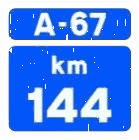
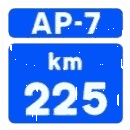
  • Kilometre marker on a motorway or dual carriageway

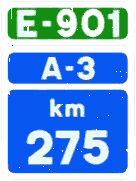
    S-570

    Kilometre marker on a motorway or dual carriageway

    Gives the kilometre point of the motorway or dual carriageway identified at the top.

  • Kilometre marker on a toll motorway

    S-570a

    Kilometre marker on a toll motorway

    Gives the kilometre point of the toll motorway identified at the top.

  • Kilometre marker on a motorway or dual carriageway belonging to an international route

    S-571

    Kilometre marker on a motorway or dual carriageway belonging to an international route

    Gives the kilometre point of the motorway or dual carriageway belonging to an international route, identified at the top of the sign.

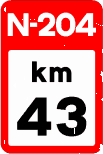
  • Kilometre marker on a conventional or multi-lane road

    S-572

    Kilometre marker on a conventional or multi-lane road

    Gives the kilometre point of a conventional or multi-lane road identified at the top, on a background whose colour matches the road's class.

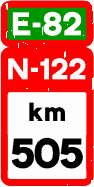
  • Kilometre marker on a conventional or multi-lane road belonging to an international route

    S-573

    Kilometre marker on a conventional or multi-lane road belonging to an international route

    Gives the kilometre point of a conventional or multi-lane road belonging to an international route, whose letters and numbers appear at the top of the sign.

  • Ten-kilometre marker on a conventional or multi-lane road

    S-574

    Ten-kilometre marker on a conventional or multi-lane road

    Gives the kilometre point of a conventional or multi-lane road when it is a multiple of ten.

  • Ten-kilometre marker on a motorway or dual carriageway

    S-574a

    Ten-kilometre marker on a motorway or dual carriageway

    Gives the kilometre point of a motorway or dual carriageway when it is a multiple of ten.

  • Ten-kilometre marker on a toll motorway

    S-574b

    Ten-kilometre marker on a toll motorway

    Gives the kilometre point of a toll motorway when it is a multiple of ten.

  • Ten-kilometre marker on a conventional or multi-lane road belonging to an international route

    S-574c

    Ten-kilometre marker on a conventional or multi-lane road belonging to an international route

    Gives the kilometre point, when it is a multiple of ten, on a conventional or multi-lane road belonging to an international route identified at the top of the sign.

  • Ten-kilometre marker on a motorway or dual carriageway belonging to an international route

    S-574d

    Ten-kilometre marker on a motorway or dual carriageway belonging to an international route

    Gives the kilometre point, when it is a multiple of ten, on a motorway or dual carriageway belonging to an international route identified at the top of the sign.

  • Ten-kilometre marker on a toll motorway belonging to an international route

    S-574e

    Ten-kilometre marker on a toll motorway belonging to an international route

    Gives the kilometre point, when it is a multiple of ten, on a toll motorway that also forms part of an international route identified at the top of the sign.

  • Ten-kilometre marker on roads outside the state network

    S-575

    Ten-kilometre marker on roads outside the state network

    Gives the kilometre point of a road that is neither a motorway nor a dual carriageway and belongs to a network other than the state's, when it is a multiple of ten. Its colour matches that road's class.

The definitions in the list follow the regulation's Spanish text. The introduction and the comparisons are ours.

Source: Reglamento General de Circulación — Anexo I, apartado 5: Catálogo oficial de señales de la circulación y marcas viales (Catálogo de señales verticales, tomo I) · Anexo I, apartado 5 (Catálogo de señales verticales de circulación, tomo I)

Get the app

Start on your phone

Everything above lives in the app for iPhone and Android. Free to start — no card needed.

ViaReady

Spanish driving theory, in your language

Get it on Google PlayiPhone — coming soon

Almost on the App Store

The Android app is already on Google Play. The iPhone app is in final testing before its App Store launch. Leave your email and we will tell you the moment it is available.

Available for iOS 15+ and Android 8+.