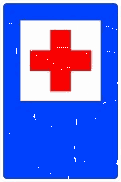
S-100
First-aid post
Marks an officially recognised centre where emergency treatment can be given.
Catalogue section 3.10
They point out a service that may be useful to road users.
How to recognise them: A square sign with a blue background and an inner panel carrying the service's pictogram.
The regulation defines these signs by their use: they tell you about a service that may be useful to people on the road. What is worth reading is which service exactly, because several differ only in a detail. On S-105 and its variants, the symbol tells you which energy is on offer: fuel, liquefied petroleum gas (LPG or autogas), electric charging, or a combination. S-104 marks a telephone and, with the wording "S.O.S", one in permanent use for alerting the authorities to a crash or an emergency on the road. For medical help there are two: the first-aid post (S-100), an officially recognised centre where emergency treatment can be given, and the ambulance station (S-101), with an ambulance on permanent duty.
The rest serve long journeys and free time: workshops, places to stay and eat, rest areas, camping in a tent or a caravan, and waste points for caravans and motorhomes. S-124 to S-126 mark car parks linked to a train, metro or bus station, so that part of the journey is made in a private vehicle and part on public transport, and S-129 marks emergency parking for snowfall. A service with no sign of its own is written in the white box of S-122.
Signs in this group that look alike, and what separates them according to their definitions.
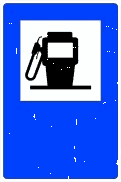 S-105
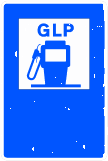 S-105c
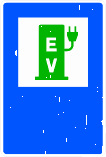 S-105e
S-105 marks fuel; S-105c only liquefied petroleum gas (LPG or autogas); S-105e only an electric charging point. S-105b, S-105d and S-105f combine fuel with one of the two or with both.
S-100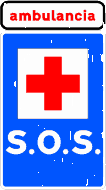 S-101
The first-aid post (S-100) is an officially recognised centre where emergency treatment can be given. The ambulance station (S-101) marks an ambulance on permanent duty to treat and carry people injured in road crashes.
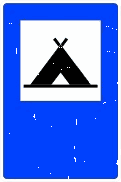 S-107
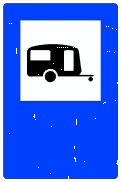 S-113
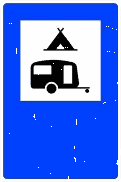 S-116
S-107 marks a place where camping is allowed; S-113 a site for camping with a caravan. S-116 combines the two.
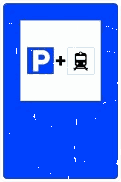 S-124
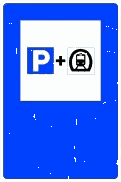 S-125
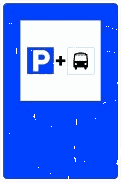 S-126
They are car parks for continuing your journey by public transport, and only the mode changes: train (S-124), metro (S-125) or bus (S-126).
34 signs
S-100
Marks an officially recognised centre where emergency treatment can be given.
S-101
Marks an ambulance on permanent duty to treat and move people hurt in road accidents.

S-102
Marks a vehicle roadworthiness testing station (ITV).

S-103
Marks a vehicle repair workshop.

S-104
Marks a telephone. If it carries “S.O.S”, it marks a telephone permanently available for reporting an accident or an emergency on the road to the authorities.
S-105
Marks a fuel pump or filling station.
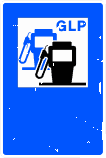
S-105b
Marks a filling station that also sells liquefied petroleum gas (LPG), or autogas.
S-105c
Marks a pump or station selling liquefied petroleum gas (LPG), or autogas.
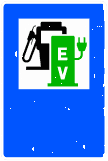
S-105d
Marks a filling station that also has an electric charging point.
S-105e
Marks an electric charging point.
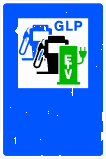
S-105f
Marks a filling station that also sells liquefied petroleum gas (LPG), or autogas, and has an electric charging point.
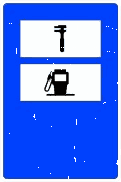
S-106
Marks premises with both a repair workshop and a fuel pump.
S-107
Marks a place where camping is allowed.
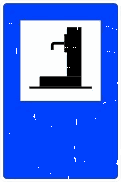
S-108
Marks a drinking-water point.

S-109
Marks a scenic spot, or the place it is seen from. Its name may be written on the sign.

S-110
Marks a hotel or motel.

S-111
Marks a restaurant.

S-112
Marks a bar or café.
S-113
Marks ground where you may camp with a caravan.
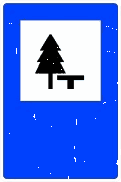
S-114
Marks a place that may be used for eating and drinking.
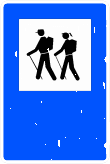
S-115
Marks a place suited to setting out on foot.
S-116
Marks a place where you may camp with a tent or with a caravan.
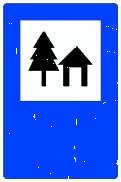
S-117
Marks a youth hostel.
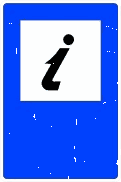
S-118
Marks a tourist information office.

S-119
Marks a lake or stretch of river where fishing needs a special permit.

S-120
Marks a park or nature reserve. Its name may be written on the sign.

S-121
Marks a historic or artistic work declared a monument.

S-122
A general sign for any other service, which is written inside the white box.

S-123
Marks a rest area.
S-124
Marks a car park connected to a railway station, meant mainly for people who make part of the journey by car and the rest by train.
S-125
Marks a car park connected to a metro station, meant mainly for people who make part of the journey by car and the rest by metro.
S-126
Marks a car park connected to a bus station or terminal, meant mainly for people who make part of the journey by car and the rest by bus.
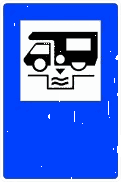
S-128
Marks a point for emptying waste water from caravans and motorhomes.
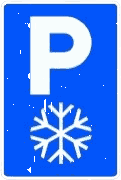
S-129
Marks an emergency parking area for snowfall and, exceptionally, for other incidents.
The definitions in the list follow the regulation's Spanish text. The introduction and the comparisons are ours.
Source: Reglamento General de Circulación — Anexo I, apartado 5: Catálogo oficial de señales de la circulación y marcas viales (Catálogo de señales verticales, tomo I) · Anexo I, apartado 5 (Catálogo de señales verticales de circulación, tomo I)
Keep going
Get the app
Everything above lives in the app for iPhone and Android. Free to start — no card needed.
Spanish driving theory, in your language
Available for iOS 15+ and Android 8+.